
Standing in Solidarity with Palestine: 6 Meaningful Ways to Show Your Support
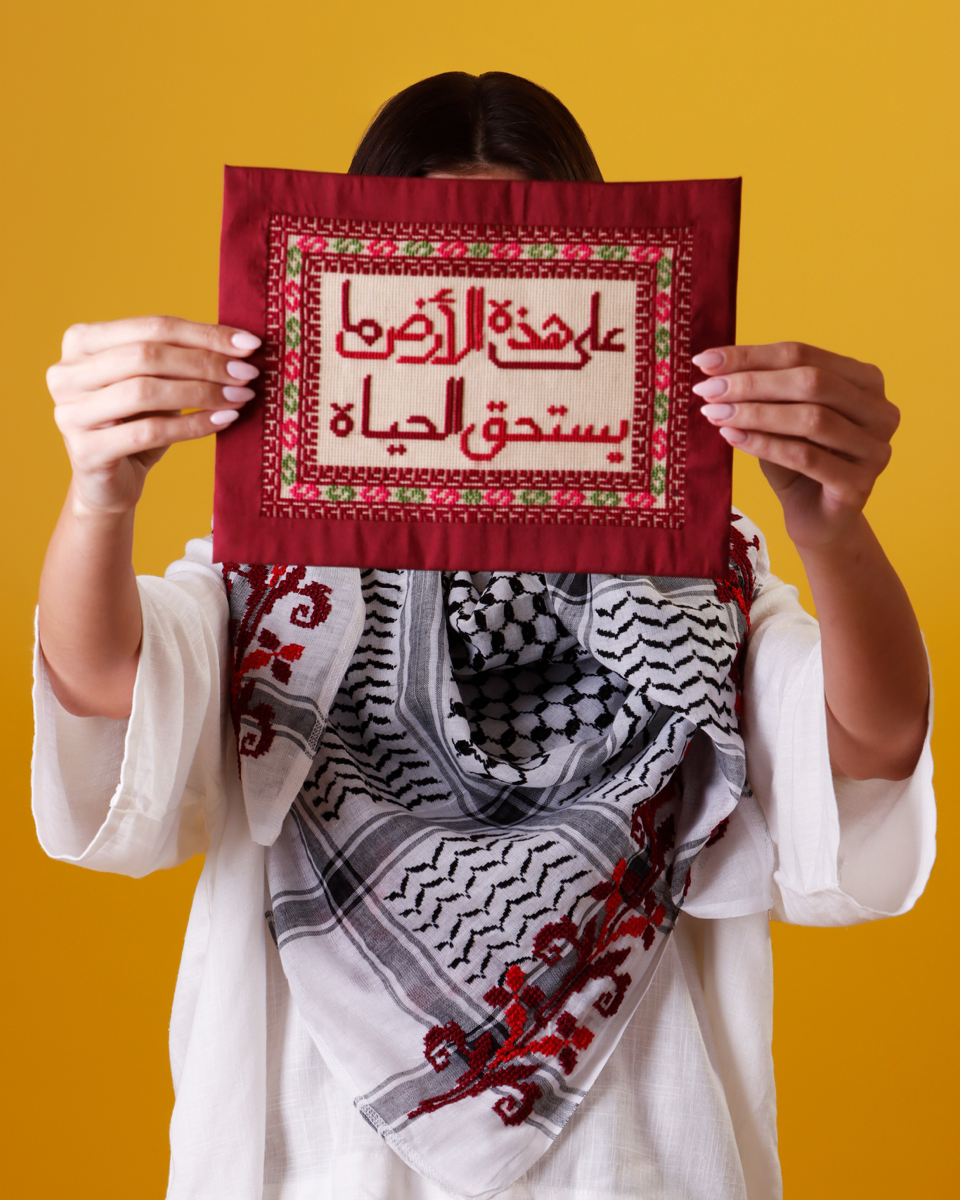
Beyond slogans and arguments, standing in solidarity with Palestine can take many forms.
This is a culture expressed through literature, poetry, oral histories, films, music, art, food, and crafts such as tatreez. Taken together they provide an array of approaches to understand and promote Palestine and its history.
At Inaash we express our support through our wide range of hand embroidered items that, in their own subtle way, tell many stories about Palestinian heritage. Through motifs, patterns, stitches and colors, created through history and across Palestine our skilled embroiderers keep the visual heritage of Palestine alive and relevant.
This support for traditional embroidery and for the women who produce it is why Inaash embroidery has persisted for over fifty years. Born of crisis but maintained through enduring commitment.
1. Be well informed
Solidarity begins with awareness and becomes effective with information.
Today there is a wealth of knowledge available about the history and reality of Palestine. The growing contributions of Palestinian historians, authors, poets, and artists, speaking of their lived experiences and those of their families, under occupation or in the diaspora, provide insight for those who support their plight.
The more we understand, the less likely the reduction of Palestine to headlines or slogans.
Making space to listen to Palestinian voices amidst the maelstrom of conflicting information is vital.
2. Support Palestinian Livelihoods
Economic support must have a direct and lasting impact.
Buying from Palestinian producers: artisans, businesses, and charities helps sustain livelihoods alongside specialised skills.
Inaash was founded in 1969 with the dual purpose of preserving Palestinian embroidery and creating dignified paid work for Palestinian refugee women in Lebanon. Today, Inaash works with more than 450 Palestinian women embroiderers, providing income through the practice of generations old traditional tatreez.
Purchasing a hand-embroidered piece therefore supports both the craft and the woman sewed it.

3. Help Preserve Cultural Heritage
Heritage survives through practice.
A motif can be photographed or stored in an archive, but keeping a craft viable depends on people continuing to make it, understand it, and pass it forward.
Tatreez cannot be easily reproduced. It’s a complex skill that involves counted stitches, colour, placement, balance, regional knowledge, and fine judgement developed through practice.
This is a key distinction in an increasingly digital world where traditional designs, and Palestinian motifs devoid of context, circulate widely. Technology is helpful for documenting and categorizing embroidery, but its preservation ultimately depends on those who continue to practise it.
Explored further in Can Hand Embroidery Survive the Digital Age?
Support for cultural organisations, artisans, and craft traditions helps ensure that heritage remains available and relevant.
4. Culture Beyond Crisis
Today, more than ever before, while Palestine dominates the news, Palestinian culture is also more visible than ever before.
A rich body of films, literature, and history books alongside prolific artistic and cultural exhibitions and programs have elevated the story Palestine and its people across the world. No longer merely a tragic news item, Palestine today is front and centre in all its facets. This proves that Hand Embroidery Survives the Digital Age.
From the Oscars to the catwalks, from concert halls to trendy restaurants, from museums to book fares, we can discover and celebrate the story of Palestine as told by those who live it, those who practice it, and those who study it. This is the work of Inaash’s most experienced embroiderers capable of sustaining concentration over many months, while maintaining the structure of the design that features dense and highly complex embroidery.
Engaging with Palestinian creativity and its cultural output generates a fuller understanding of Palestine: not simply as a place marked by conflict, but as a society with its own aesthetics, humour, traditions, and continuous creativity.
5. Share Palestinian Stories Responsibly
What we choose to share and how we share it matters.
Behind the tragic portrayals and the shocking news stories is a much more potent narrative about Palestinian society as whole, its traditions and values, its crafts and cultural heritage, its position in the world today outside the assigned role of tragedy and victimhood.
The story about a woman in exile embroidering in a refugee camp speaks simultaneously about earning a livelihood, supporting her family’s future, safeguarding her technical skill, and contributing to cultural continuity. The way her story is told makes all the difference. Inaash blog_ 1
Sharing well researched information, properly attributed, creates a new level of respect of the people whose stories are being told.
Solidarity should amplify Palestinian voices, not replace them.
6. Support Trusted Humanitarian Work
Cultural support and humanitarian support serve different needs, and both matter.
For people affected by conflict, immediate practical assistance: food, medical care, shelter, water, education, and other essential services are vital, but knowing the most ethical methods of fundraising and distribution is important.
Before donating, it is worth taking the time to pinpoint appropriate organizations to learn who they serve, how they operate and where contributions come from and are directed to. Inaash blog_ 1
Thoughtful giving begins with understanding needs and supporting organisations best equipped to respond to them.
Solidarity That Lasts
Solidarity takes many forms:
Supporting education and livelihoods,
Protecting cultural knowledge,
Encouraging creative endeavors,
Sharing stories responsibly,
Contributing to humanitarian work.
All forms of solidarity are invaluable but they are most effective when they are well placed.
For Inaash, preserving Palestinian embroidery has always been inseparable from supporting the women who make it. The craft survives because it is supported, adapted, valued and promoted.
A piece of tatreez contains hundreds or thousands of skillfully executed stitches. Behind it is memory, expertise, time, patience, dedication, and a commitment to teach it from one generation to the next.
-
Posted in
Alserkal Avenue, Dubai, Inaash
