
Can Hand Embroidery Survive the Digital Age?
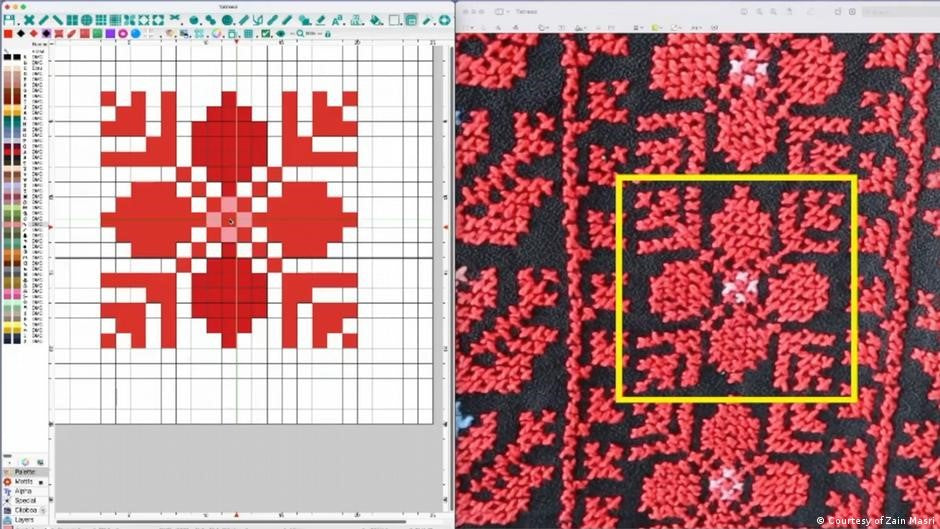
In a world of speed, screens, and instant production, Palestinian tatreez still holds firm thanks to skilled handiwork
We live in a time where almost everything can be copied, printed, shared, and sold in seconds.
A pattern can be instantly produced on a screen. A machine can repeat a design thousands of times. A digital image can replicate a piece of embroidery without a needle touching fabric.
So where does this leave hand embroidery?
At Inaash, the answer is simple: hand embroidery does not survive the digital age by trying to catch up. It survives by becoming better known and understood.
What Technology Can Do
Technology is not an adversary of craftwork, it can help promote it.
Digital tools can be used to photograph vintage garments, archive motifs, create embroidery charts, document regional patterns, and encourage younger generations to explore traditional Palestinian embroidery. In an instance, for example, the significance of a small embroidery piece made in Lebanon can be conveyed to a customer on the other side of the world.
In this sense, the digital age gives Palestinian tatreez new visibility.
A motif once only found on a local village dress, as a family memento, or in an archive can now be seen, studied, and appreciated by people far beyond its original location. This matters, especially for a heritage that has frequently struggled to survive throughout displacement, in the memory and skills of women who carried their traditions in their hearts.
But visibility is not the same as preservation.
An online pattern can travel quickly, but it can also lose its context. A motif copied without context loses its meaning. A traditional design can be reduced to an undesignated decoration. The digital world can spread visuals, but it can also disconnect their meaning.
This is where human skill remains essential.
What Technology Cannot Replace
A machine can replicate the appearance of embroidery. A print can reproduce the image of a motif. A digital file can store a pattern.
But none of these can replace the knowledge and skill of the woman who stitches it.
Hand embroidery is not simply about a final image. It is about the delicacy of the needle, the tension of the thread, the counting of the stitches, the choice of colours, the rhythm of repetition, and the quiet judgement that happens while a piece is being sewn.
In Palestinian tatreez, every stitch requires attention. The embroiderer follows a counted pattern, balances the motif, adjusts the thread, and monitors how the embroidery sits on the fabric. Even if the design is pre-planned, it takes skilled handiwork to bring it to life.
This is how handcrafted embroidery can be differentiated from something printed or machine-made.
The thread has depth. The surface has texture. The motif carries significance. Small variations alert us to the fact that this is made by hand not by machine.
And in a world where so much is produced quickly and forgotten just as quickly, that human touch becomes even more valuable.
Slow Work in a Fast World
The digital age has changed the way we look at objects.
We scroll quickly. We buy quickly. We move from one image to the next without fully seeing what is in front of us. Fashion has become fast, with collections produced and replaced at speed often leaving little room for care, longevity, or meaning.
Hand embroidery demands the opposite.
It asks us to slow down.
An embroidered Inaash piece cannot be rushed into completion. Even before the first stitch is done, the fabric, the motif, colour palette, placement and scale must be decided upon. The design is reviewed, adjusted, and approved. The thread colours are carefully selected. Then the piece is sent to the Inaash camp supervisors for distribution to the women who begin the embroidery stitch by stitch.
Some pieces take days. Others take weeks or months.
The time taken is not an obstacle, it brings value to the piece.
Choosing a hand embroidered piece means giving value to something that requires hours of labour, patience, and skill. A piece made to be cherished, worn with pride or gifted with love.
The Danger of Becoming “Just a Pattern”
A big risk in the digital age is that traditional designs become disassociated from the people and cultures that created them.
A Palestinian motif can easily be copied and used without its context. A tatreez pattern can appear online with no mention of its origin, region, meaning, or maker. The danger is that what was once part of a living cultural language could simply become an “ethnic” design.
At Inaash, this is precisely what we work to prevent.
Palestinian embroidery is not simply an add on decoration. It forms the very heart of the piece. Motif, colour, fabric, and form are all considered as one, whether for a garment, bag, cushion, tableware, or large scale textile artwork.
This matters because tatreez is not only beautiful, it is also a visual cultural language.
Its patterns express memory, place, a sense of identity, and the collective work of generations of women. To preserve it properly, we must protect not only the motif and patterns, but also those who stitch it, the women who carry the skill, and know the context that gives the design meaning.
Inaash’s Answer to the Digital Age
Inaash was founded in 1969 by Huguette Caland, daughter of former Lebanese President Bechara El Khoury, together with likeminded Palestinian and Lebanese women. From the beginning, the mission was clear: to preserve traditional Palestinian embroidery while providing dignified, paid work for Palestinian refugee women in Lebanon.
Today, that mission is more relevant than ever.
Inaash works with more than 450 Palestinian women embroiderers. Since its inception, more than 3,700,000 pieces have been embroidered through Inaash. These numbers are important because they show that preservation is not only about keeping old pieces safe. It is about keeping the craft active.
A tradition survives when it is practised.
Through Inaash, Palestinian embroidery continues to embellish classical pieces, contemporary summer and winter collections, bags, accessories, homeware, and large textile artworks. This range allows tatreez to enter new spaces: wardrobes, homes, galleries, and museums while triggering contemporary design conversations.
The digital world helps Inaash to showcase this work. But the work itself showcases the skills of those who embroider it.
The Future Is Not Machine or Hand. It Is Meaning.
The question is not whether hand embroidery should reject the digital age or whether the digital age threatens its future.
It should not and it does not.
Technology can help preserve archives, tell stories, reach customers, and connect the world to the women behind the work, enabling Palestinian embroidery to become more visible and better understood.
But technology must serve the craft, not replace it.
The future of hand embroidery depends on keeping its narrative safe and relevant: the stories behind the motif, the makers, the fabrics, the process, the empowerment of the women, and the cultural memory conveyed with every stitch.
A machine produces an image.
A hand-embroidered work carries a presence.
Hand embroidery can survive the digital age. Not by competing with it but by offering what it cannot provide: context, texture, and a story told through the unmistakable skill of a human hand.
