
Hand Embroidery vs. Machine Embroidery: Why the Difference Matters
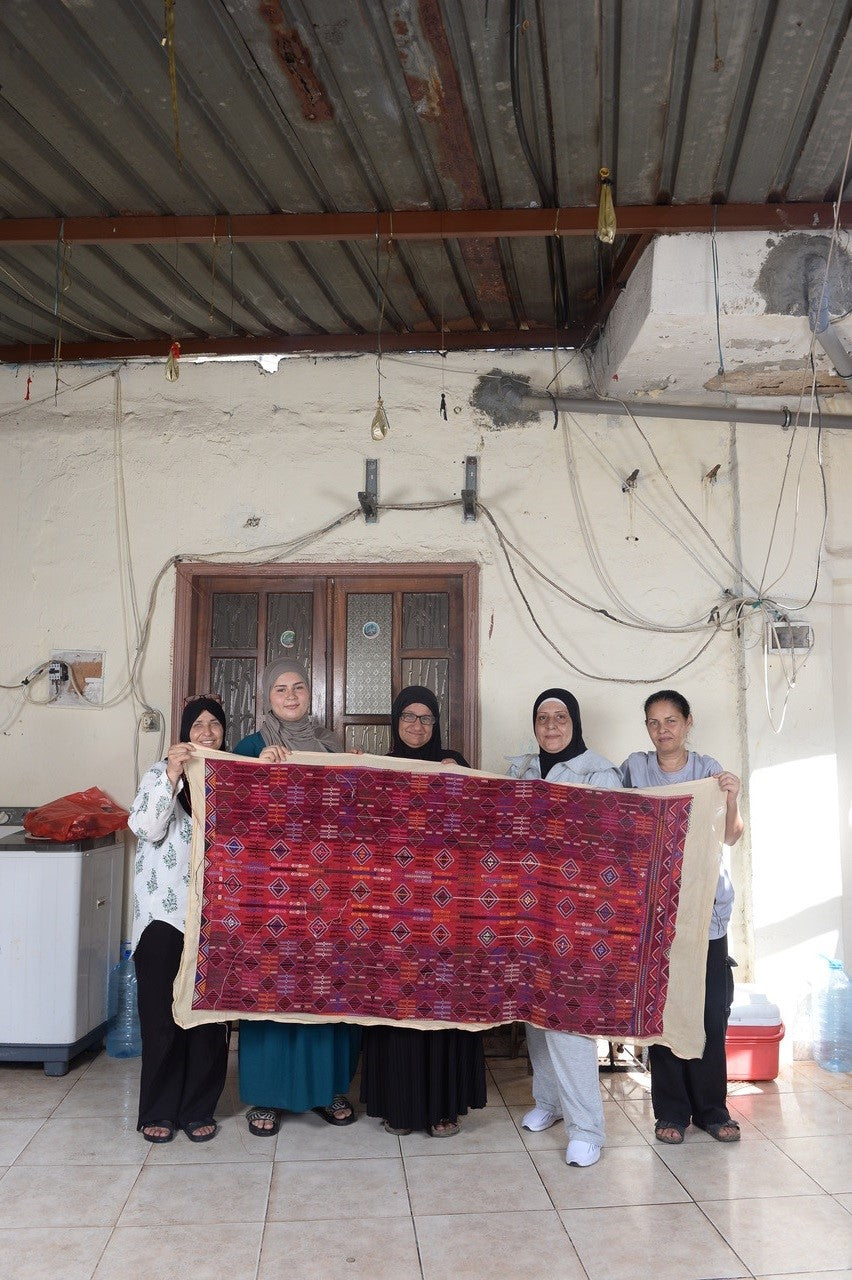
At first glance, hand embroidery and machine embroidery appear to be similar.
Both are stitched. Both feature specific motifs. Both are beautifully decorative.
The difference becomes clear when you take a closer look — and even more so when you touch the surface of the work.
Machine embroidery executes a programmed design with speed and precision. Hand embroidery is impacted by the skill of an individual: the pressure of her hand, the rhythm of her needle, the tension of the thread, and the small decisions taken as the design comes to life.
For Inaash, this difference is essential. Palestinian embroidery, known as tatreez, is not simply a pattern to be copied. It is a vibrant craft created by generations of women, shared through decades of skill, and still practiced till today.
Every Embroiderer Has a Handwriting
Hand embroidery can be understood almost like painting.
Just as no two painters leave exactly the same brushstroke, no two embroiderers stitch in exactly the same way. Each woman has her own pressure, pace, needle technique, and rhythm. Her work leaves a quiet signature on the fabric.
This is why no two hand-embroidered Inaash pieces are ever 100% identical.
They may share the same motif, belong to the same collection, and use the same thread colours and fabric, but each one carries the touch of the woman who made it.
These small differences are not flaws. They are the signature of hand embroidery.
They give the piece texture, warmth, variation, and character. Instead of anonymous perfection, the work reveals something more intimate: the presence of the maker.
The Texture You Can See and Feel
Hand embroidery has depth.
The thread impacts the fabric with weight and texture. Small raised details, slight variations, and the visible rhythm of work made stitch by stitch punctuate the surface.
In Palestinian tatreez, this matters deeply.
Tatreez depends on stitch counts, balance, geometry, colour, and placement. A motif is not simply pressed onto fabric; it grows stitch by stitch under close attention. While the embroiderer plots the structure of the design, she exerts her skill and experience to execute the work.
This is not mechanical perfection.
It is human precision.
Why Inaash Chooses the Hand
Inaash was founded in 1969 by Huguette Caland, daughter of former Lebanese President Bechara El Khoury, together with likeminded Palestinian and Lebanese women. From the outset the mission was to preserve traditional Palestinian embroidery while providing dignified, paid work for Palestinian refugee women in Lebanon.
Today, Inaash works with more than 450 Palestinian women embroiderers. In their hands, Palestinian tatreez remains active, visible, and relevant.
This is why hand embroidery is significant no matter what the finished object. It provides women’s livelihoods. It promotes their skill. It keeps their inherited knowledge in practice. It allows Palestinian embroidery to continue not only as a historical reference, but as a living craft that women still make and carry forward.
A machine can reproduce the shape of a motif. But it cannot support a woman through her craft, preserve the knowledge held in her hands, or carry on the continuity between one generation and the next.
The Inaash Process
An Inaash embroidered piece does not begin with a needle. It begins with a design decision.
First, the fabric, canvas, or item to be embroidered is chosen. A garment must move well on the body. A bag must be practical and strong. A cushion or home item must make an impact in an interior. A large textile artwork must achieve balance, scale, and presence.
Then comes the embroidery.
The motifs, colours, placement, and proportions are discussed and reviewed. The design committee considers how the embroidery suits the item, whether the scale feels right, and whether the colours work with the fabric. Adjustments are made before the piece is approved.
Once the design is ready, the thread colours are chosen. The materials are then prepared and sent through Inaash’s camp supervisors to the women embroiderers.
Only then does the stitching begin.
After the embroidery is complete, the piece is returned for checking, finishing, sewing, assembly, and quality control. The finalized item must be well-made, well finished, before being signed off as ready to wear, to carry, display, or used in the home.
This process is part of what gives Inaash products their value. They are built through design, embroidery, supervision, finishing, and care.
More Than a Pattern
Today, there could be a risk that embroidery becomes reduced to merely an image.
A motif can be copied. A design can be printed. A traditional pattern can be reproduced without reference to its origin or meaning.
But Palestinian embroidery is not just decorative. It is a visual cultural language expressed in motifs, colours, and compositions that speak of place, memory, identity, and the generations of women who maintained its traditions.
This is why, at Inaash, embroidery is never simply an add on, never just ornamentation. It is, in fact, central to the identity of our work, whether it is applied to a dress, a top, jacket, bag, cushion, table runner, or wall hanging.
It defines the object. It gives it presence. It connects it to a wider story.
Why the Difference Matters to the Customer
Our hand-embroidered items are not exceptional simply because they are “handmade.”
Their value comes from the careful process that goes into making them: design research, motif selection, colour approval, skilled embroidery, close supervision, finishing, and quality control.
And each piece is unique, no two are the same, the differences may be subtle but they are there.
When you buy a hand-embroidered Inaash piece, you own something that no one else has. A piece individually crafted by a skilled artisan.
That is the subtle luxury of hand embroidery.
No commercial branding. Not mass production. No superficial decoration.
Simply a piece with character.
Frequently Asked Questions
Is hand embroidery better than machine embroidery?
Machine embroidery has its place. It is fast, consistent, and useful for large-scale production.
But for Inaash, hand embroidery carries a value that machine embroidery cannot provide. It supports women artisans, preserves Palestinian tatreez as a living craft, and gives each piece texture, depth, and individuality.
Why does hand embroidery cost more?
Hand embroidery costs more because it requires skilled labour, time, and an artisanal production process. The price reflects the design process, materials, embroidery hours, supervision, finishing, and the expertise of the women who create each piece by hand.
Why are hand-embroidered pieces not identical?
Because every embroiderer has her own touch.
Like brushstrokes in a painting, stitches vary according to the techniques applied by the embroiderer: the pressure exerted, the rhythm of her stitches, the movement of the needle and the tension of the thread. These variations dictate the individuality and authenticity of hand embroidery.
Can machine embroidery replace Palestinian tatreez?
A machine can reproduce an image of a tatreez motif, but it cannot replace the cultural knowledge, human touch, the inherited skill underpinning hand-stitched Palestinian embroidery and the valuable income it brings to the embroiderer.
The Life Behind the Stitch
The difference between hand embroidery and machine embroidery is ultimately a difference in meaning.
At Inaash, this is what we protect: not simply the motifs, but the embroiderers; not only the patterns, but the process; not only the beauty of Palestinian embroidery, but the women who keep the tradition alive.
A machine can mass produce but it cannot nurture wellbeing.
