
The Road to Ramallah: Ahmed Amer on Memory, Movement and Palestinian Embroidery
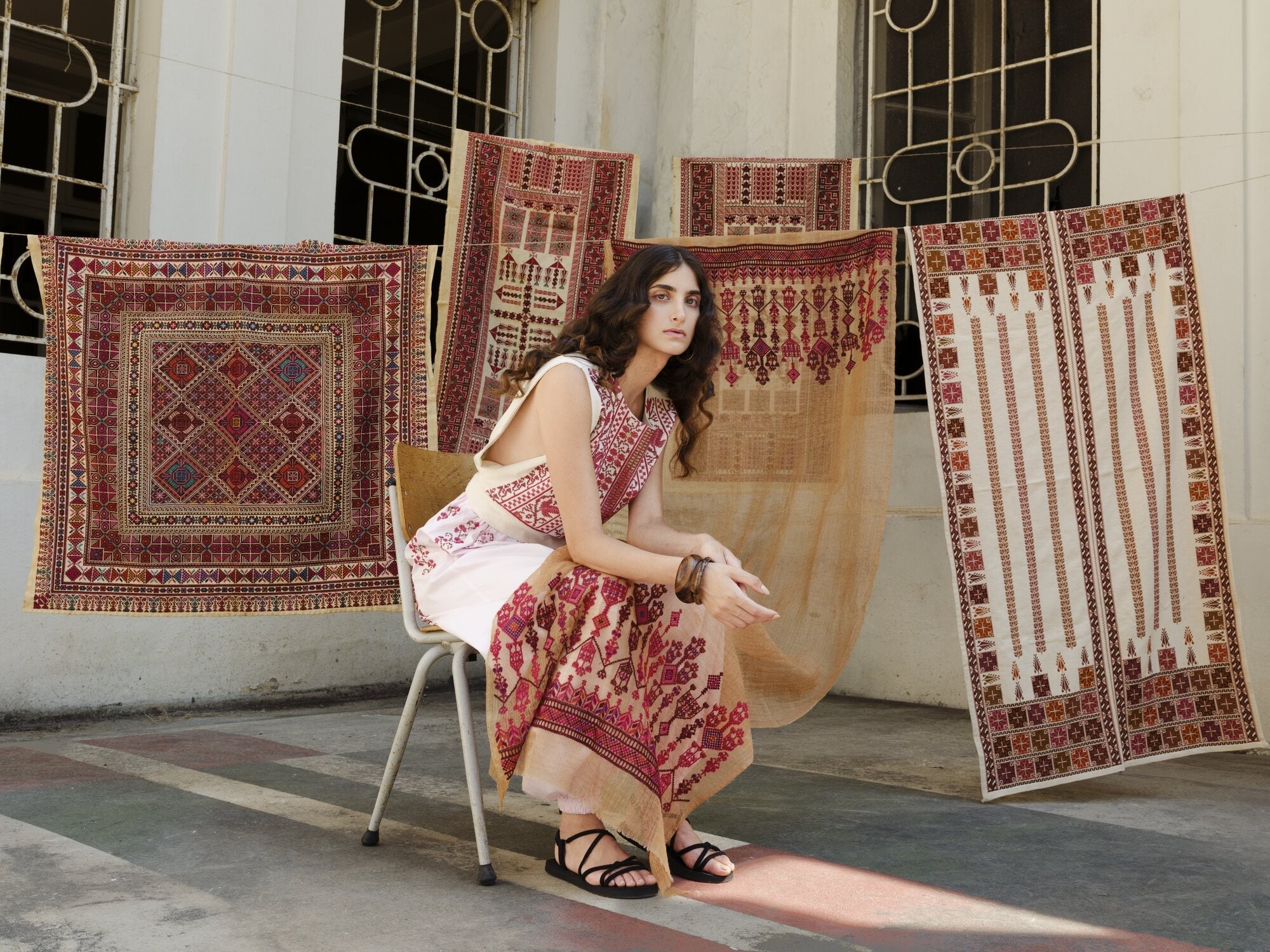
For Inaash’s Spring/Summer 2026 collection, designer Ahmed Amer turns toward Ramallah—not simply as a city, but as a landscape of memory, craftsmanship and cultural continuity.
Entitled The Road to Ramallah, the collection is built around the Palestinian motifs and stitches that over time came to symbolize Ramallah, now reinterpreted in Amer’s contemporary designs. These traditional motifs illuminate flowing dresses, pleated skirts, sculptural tops, casual sets and sweeping thobes, in a collection that synchronizes heritage and design.
At its heart lies the central question: how can Palestinian embroidery, rooted in its history, evolve and remain relevant to discerning clients?
A Song Becomes a Journey
The inspiration for collection began with the Palestinian song “Wen 3a Ramallah” — “Where to? To Ramallah.”
For Amer the song is about hope, longing and the dream of return. It became the emotional foundation of the collection, with tatreez as the visual language through which its story unfolds.
As Amer explains:
“Throughout my practice, I often draw inspiration from existing cultural narratives, traditions, songs, crafts and collective memories, then reinterpret them through fashion and contemporary design.”
“The song title refers to more than a physical road, it is also about an emotional and cultural journey. It speaks of memory, longing, belonging and return,” Amer says.
Therefore, the collection is not simply about remembering Ramallah, it is also about carrying its heritage forward.

Why Ramallah?
Palestinian embroidery is not uniform. Historically, colours, motifs and compositions varied between cities, villages and regions.
During his research, Amer was particularly drawn to the embroidery of Ramallah, known for its dense, refined compositions and striking red thread on off-white or beige fabric:
“There is something incredibly alive about Ramallah’s visual language,” he explains. “The iconic red embroidery on off-white and beige fabrics immediately captured my attention.”
This combination became the foundation of the collection’s palette. Its red evokes vitality, strength and celebration, while the beige natural fibres woven into handmade cloth recall stone built architecture.
Black is used throughout the collection as a contrasting colour, for depth and focus. The palette then expands into olive green, sky blue, dusty pink, soft yellow, earthy brown and deeper shades of red; colours drawn from the Palestinian landscape: olive groves, cultivated fields, wildflowers, limestone buildings, gardens and open skies.
This way Amer gave the collection a feel that captures that landscape by conveying its colour, texture and visual memory.

Tradition in Motion
While remaining faithful to Inaash’s values of comfort, modesty, elegance and craftsmanship, The Road to Ramallah introduces a more playful sense of style.
Balloon hems, pleated skirts, voluminous trousers and sculptural tops create youthful, expressive silhouettes. While some garments are loose and fluid, others are more structured and gently shaped to the body.
“The silhouettes shift between relaxed comfort and sculptural elegance.”
Along with this balance between softness and structure, ease and refinement, several pieces take a unisex approach: relaxed shorts, loose collared tops, adaptable matching sets suitable for both genders and different shapes and sizes.
The fabrics were selected to reflect a sense of lightness and movement. Cotton, linen, cotton-linen blends, viscose voile and lightweight crepes for breathable and comfortable garments even while supporting pleats, volume and sculptural forms.
As Amer puts it:
“The mood of the collection is built around comfort, lightness, movement and the feeling of embarking on a journey.”

Tatreez as a Living Language
The collection incorporates a rich range of traditional Ramallah motifs, including floral vases, birds, doves, roosters, cypress trees, candlesticks, stars, palm trees, amulets, chains, almond branches, vine leaves and geometric borders, all chosen for their deep symbolic value. Together, they form a visual language shaped by nature, everyday life, spirituality, celebration, protection and the relationship between people and their surroundings.
“They are by no means isolated decorative elements, together they form a narrative that reflects life as lived in Ramallah throughout history,” Amer explains.
The placement of the motifs on the garments was carefully conceived and follows several approaches. Some pieces preserve the traditional layout of historic Palestinian garments, using classic chest panels, sleeve borders and vertical compositions.
In others, the embroidery follows the logic and movement of the designs. On garments such as satin skirts and structured tops, the motifs are positioned to emphasize seams, shape and proportion.
Other pieces, such as the balloon dress or the white satin open abaya, approach the garment like a canvas where the motifs flow across the surface, creating a sense of rhythm and spontaneity.

Reinterpreting Without Erasing
While maintaining respect for the traditional motifs, Amer experimented with scale, spacing and repetition.
Some motifs were enlarged, with more space between stitches, giving the embroidery a lighter visual impact. Others were mirrored, repeated or combined to create larger compositions.
In certain cases, specific details were extracted from traditional motifs and repositioned; for example the heart from within the vase motif was isolated and used in its own right in a new way.
The idea, Amer explains, is that:
“These interventions allow the motifs to remain recognisable while introducing fresh perspectives and contemporary interpretations. Rather than transforming the embroidery itself, we focused on creating new dialogues around it through the silhouette and garment designs.”
The heritage remains visible, but the clothes fit naturally within a contemporary wardrobe.

The Thobe at the Heart of the Collection
Among all the pieces, it is the thobes that most fully represent the idea behind The Road to Ramallah.
They were the starting point of the collection and remain its strongest link to Ramallah’s embroidery traditions. Their sleeves feature floral borders and botanical elements, while their central chest panels are, as has always been the case, the focal points filled with symbolism.
“The thobe is more than a garment, it expresses memory, identity, craftsmanship and cultural continuity.”
The red thobe is also one of the collection’s most technically demanding pieces taking several months of intensive work. Its dense embroidery is accompanied by detailing along the hem, requiring hours of dedicated handiwork.

A Collaborative Process
Choosing the embroidery and how and where to place it involves a whole collaborative process which takes into account a number of factors.
It starts with researching Inaash’s rich archive of motifs and stitches to select a list of potential designs for embroidering, keeping in mind the fabrics to be used and the sewing skills of the different embroiderers working on the project.
No motif is selected in isolation: the design team first considers the fabric, silhouette, colour and mood of each piece, and then the embroidery is chosen in response to the garment.
This process brings together Amer, assistant designer Patile and Inaash coordinator Samar, who guides the team in researching Inaash’s archives and sourcing traditional references.
The Inaash embroiderers also play an active creative role. While the design team chooses the primary and secondary thread colours, the embroiderers decide how those colours are distributed within the motifs. Their experience, judgement and personal interpretation shape the final appearance of every garment.
Through this collaboration, each artisan’s expertise becomes a vital component in the visible impact of the collection.
“Their contribution goes beyond craftsmanship; they are active participants,” Amer says.

Made to Be Worn
Amer conceived the collection to be worn by a broad, intergenerational group: younger people discovering Palestinian culture; their mothers and grandmothers familiar with its traditions; and designers, artists and cultural advocates with an appreciation of the history and aesthetic impact of the collection.
Amer sums it up:
“Every piece is an invitation to wear not only a garment, but also a story.”
Some pieces, including those with embroidered chest panels, skirts and abayas, are designed as versatile wardrobe staples. They can be styled with simple shirts, T-shirts, jeans or tailored trousers.
Other, such as the balloon dress, white embroidered dress and sculptural vests, have a more collectible presence.
Even the most elaborate garments, however, are designed to be worn effortlessly and often.
Amer recommends effortless styling: minimal jewellery, sculptural bracelets, simple sandals or flat shoes. The embroidery remains the focal point while the wearer’s own personality comes through. (This has already been quoted way higher in the piece and highlighted in green)

Carrying the Story Forward
The Road to Ramallah reflects Inaash’s wider mission to preserve Palestinian embroidery while supporting the women who create and conserve it. And to present tatreez not as a historic craft, but as a living visual cultural language relevant to contemporary design, and for wardrobes of fashion-conscious shoppers.
The Ramallah Palestinian motifs used in the collection — flowers, birds, doves, cypress trees, stars, palms, amulets, and geometric borders – play an important role in this.
Amer and the team believe that by using these traditional motifs in contemporary silhouettes and everyday garments, they help ensure that their stories continue to be seen, worn, shared and appreciated by new generations.”
At a time when cultures face displacement, appropriation and erasure, preservation cannot remain passive. It requires documenting, teaching, making, wearing and sharing.
For international audiences, Amer hopes the collection offers a deeper view of Palestinian culture—one shaped by beauty, complexity, knowledge and craftsmanship.
For Palestinians, he hopes it inspires something more personal:
“I hope they feel pride, belonging and recognition. I hope they see their culture represented with care, beauty and respect.”
The Road to Ramallah is a journey of memory, heritage and hope—a celebration of Palestinian embroidery as a living archive, carrying stories from the past into the future to be seen, shared, remembered and cherished.