
Wearing Stories, Not Trends: The Meaning Behind The Embroidered Keffiyeh
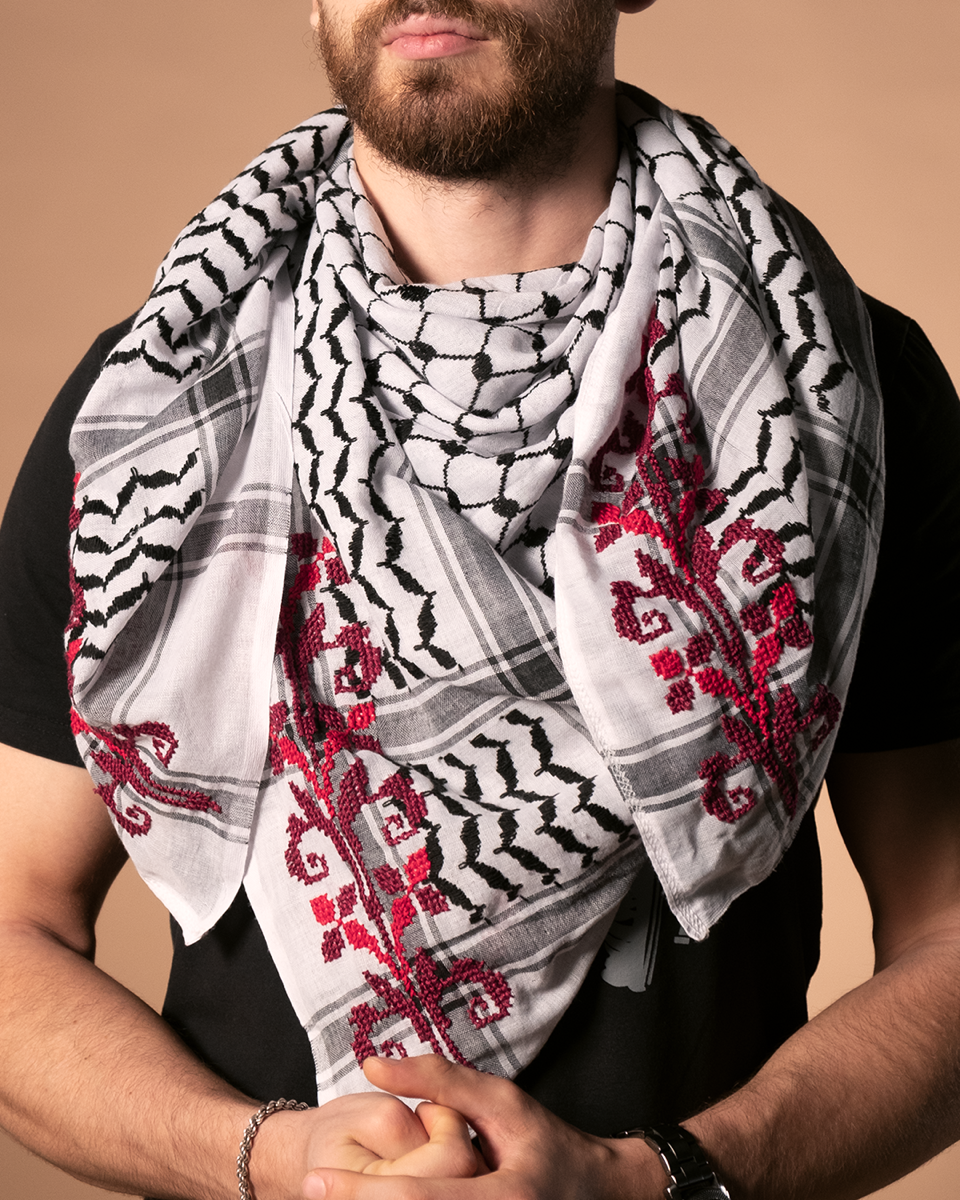
What you wear can say a lot about you, who you are, what you believe in. While some garments are simply worn, others become statements. Palestinian women’s clothing, historically and even today, speaks of identity and belonging. Through the motifs on their intricately embroidered dresses, they tell the story of their land, their status and their history; their needlework representing a visual language passed down from mother to daughter across generations. As Zoya, an Inaash artisan, states, “When you wear a dress, you don’t feel like you’re wearing cloth; you’ll feel that you’re wearing a memory stitched into it.”
The Language of Stitches
Our artisans believe that in order to understand the symbolism of the embroidered keffiyeh, you must first understand the meaning of tatreez, traditional embroidery, the bedrock of Palestinian culture. For centuries, Palestinian women embroidered their garments not simply to beautify them but also as a means of communication. Through their tatreez they developed a system of motifs, colours, and patterns that conveyed their personal history and status at a glance
Different regions developed their own visual signatures. For instance, the richly embellished Bethlehem stitching contrasts directly with the patterns and colors used in Gaza Just as accents can identify a person’s original location, so too dress patterns can identify place of origin. As a textile historian explains, “You can read a dress like a map. It tells you where a person belongs.”
The Keffiyeh
Something powerful happens when these motifs are embroidered onto a keffiyeh—combining two emblematic cultural symbols – into something more meaningful:
- Embroidery as language of storytelling
- The keffiyeh as a symbol of identity and resistance
The iconic keffiyeh comes from humble origins, used by farmers and Bedouins to protect themselves from dust and sun. The keffiyeh was merely practical but over time in the struggle for liberation it evolved into a national symbol.
With the addition of well-chosen motifs, the embroidered keffiyeh takes on deeper symbolism.
Stitches such as the:
- Bold lines representing historic trade routes
- Nature motifs symbolizing resilience and rootedness
- Fishnet designs reflecting connections to coastal livelihoods
Such symbols are fragments of lived experience—land, sea, struggle, and survival. As a young embroiderer explains: “Every pattern is formed from a memory. They remind me of my identity.”
Why the Embroidered Keffiyeh Matters Today
In today’s world of fast-fashion, trends evolve overnight only to quickly die out. The embroidered keffiyeh resists that cycle. It is form of craftsmanship that has been recognized by UNESCO as intangible cultural heritage. This global recognition reinforces the identity of generations of Palestinians.
As one young man explains, “I wear it because it reminds me where I come from, even if I’ve never been there.”
Others says, “For me, it’s a form of respect—not just a fashion statement.”
The stories told through the embroidered keffiyeh are the product of generations of women who shared their designs and ideas and stitched them together throughout decades. An artisan recalls, “My grandmother taught my mother, and I learned from my mother.” This is how the legacy continues.
Scholars describe Palestinian embroidery as a “visual archive”—a way of preserving history even when physical spaces and memories are disrupted.
As one cultural researcher notes:
“Even if our stories are erased, we stitch them back into cloth.”

Wear Stories, Not Trends
In a world of seasonal collections and fleeting aesthetics, the embroidered keffiyeh endures: as memory, identity, resistance, and belonging stitched as stories by artisans who are the guardians of heritage.