
Every Motif Tells a Story: Understanding Palestinian Embroidery Motifs
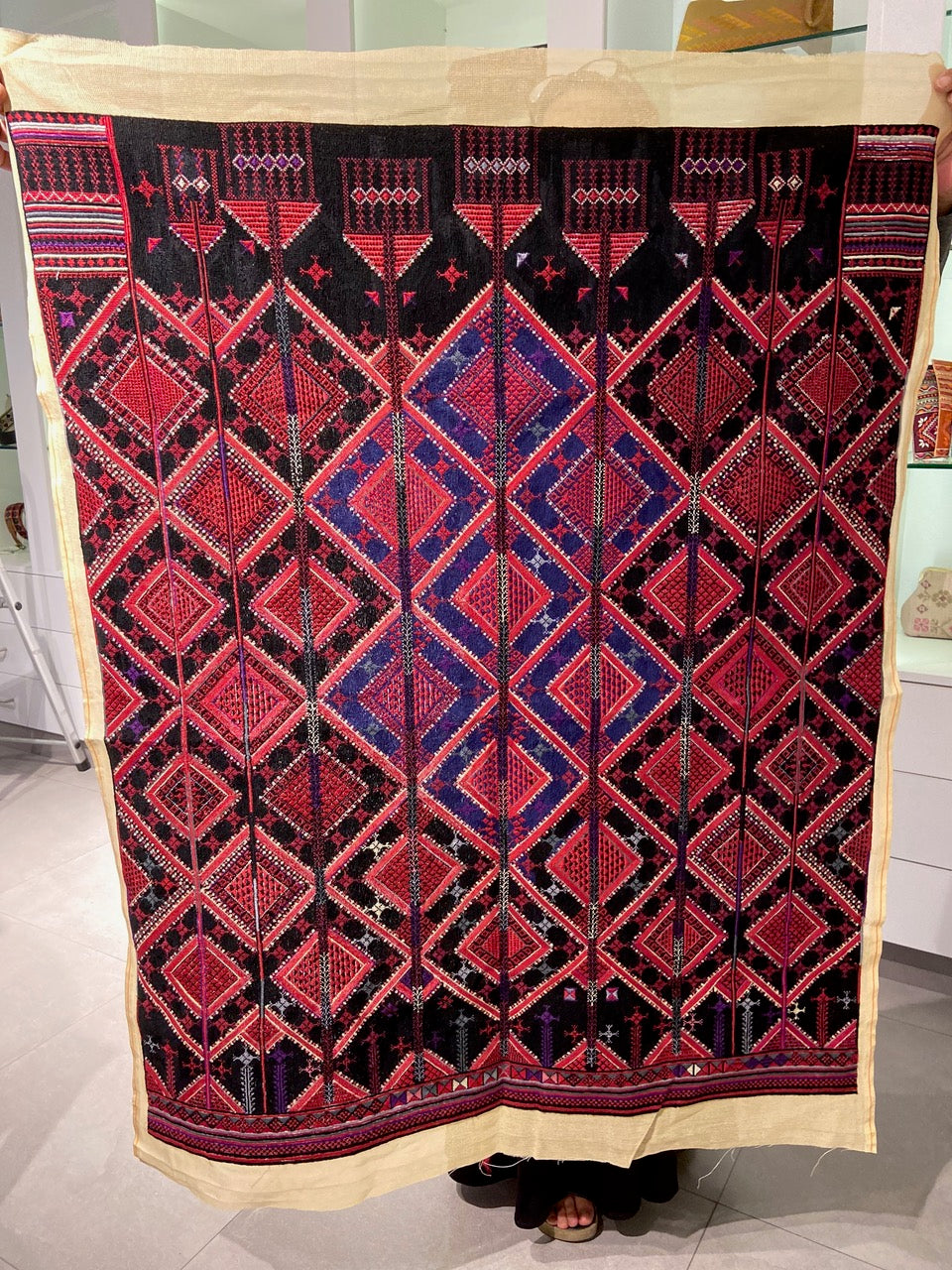
Some stories are spoken out loud, some are read silently and some are told in stitches and patterns. Palestinian embroidery motifs tell stories of cities, villages, traditions and social events. They convey rural tales, urban trends, geographic locations and above all a sense of belonging to an ancient land. Palestinian embroidery, tatreez, developed over centuries and across generations, is a testament to a land and its culture.
What can we understand from a motif?
For Mariam the motifs she depicts illustrate meaningful symbols that typified a woman, her village, and her story. Traditionally the motifs stitched on the chest panel of a woman’s dress conveyed her geographic location and often her social status. In other words, these motifs reflect the story of a society rich in history and culture.
Established in 1969, Inaash supports thousands of Palestinian women in Lebanon through the embroidery of these motifs. These symbols not only keep their heritage alive they are also a key source income, helping women to feed and educate their families.
Mariam stretches the fabric and adjusts it in her hands. Her needle probes the material carefully, its thread forming shapes that seem familiar, yet not quite clear. What is the meaning of these patterns?
Mariam reflects for a while then replies, "It depends on where you come from.” This is the essence of Palestinian embroidery motifs, while some may seem easy to decipher, they nevertheless resonate with deeper symbolism rooted in memory and place. As such they evolved from the routines and patterns of everyday life, through decades and across generations.
Palestinian Embroidery Motifs as a Language of Identity
As one woman puts it “We didn’t need introductions, you could look at a woman’s dress and know where she belonged." In decoding a woman’s story from her dress, you might discover agricultural abundance, trees, fruits and vegetables. From another you might trace her life’s journey from bride to widow. For another the sophistication she gained by living near one of the great historic cities of Jerusalem, Nazareth or Bethlehem. Each motif spells out the language of identity.
Reem, another artisan, states, “They act as fingerprints. Even if they look similar, no two seem exactly the same.”
You can observe the motifs over time but they can never be taught in the abstract.
As Reem puts it, “Instead of learning the names first, I learned the rhythms. Later, I perceived what they meant. My mother taught me to select the pattern carefully because this is how we are telling people something about ourselves. This is the essence of Palestinian embroidery motifs - they’re not chosen randomly. We select, repeat, and pass it on with intention.”
Palestinian embroidery motifs are not just a powerful feature of history; they showcase the ability to carry that history forward.
Or as stated by Unesco "Tatreez has been practiced for thousands of years and is now familiar as an intangible cultural heritage. It represents the significance of preserving the Palestinian identity across generations."
From Tradition to Livelihood
The role of embroidery has changed over the years from its earliest days as an indigenous form of artistic expression to a powerful visual language with the means not only to convey identity but also to generate livelihoods for those displaced in refugee camps across the region. In Lebanon where many Palestinian women live out their days with limited opportunities, Inaash has trained and supported hundreds of women in order for them to generate an income from their embroidery skills through handcrafted pieces curated to carry their heritage into global markets.
As one artisan explains, “I stitch every day because this is what I know; this is what roots me. This is not a compulsion; it’s a desire to be recognized across the world.”
This is how what once existed within the private space of a home has now become a part of a sustainable ecosystem.
Helping:
● By preserving the cultural identity
● By supporting families
● By providing income
The combination of tatreez with contemporary designs has created a new context for the women to promote their skills “Instead of losing the meaning, we are giving it a new place to live.”
Through this collaboration with Inaash, centuries-old motifs are emblazoned on jackets, decorate cushions, embellish classic shawls, or are created as art pieces. Thus, the blend of contemporary and traditional in the form of garments, household goods, soft furnishings and others help to keep the language of identity alive and traditional heritage relevant. Reflecting on these trends an older embroider said, “Our daughters use new colours and new styles but when we look closely, we see the same story.”

Stories That Endure
The bridge between past and present is keeping the symbols alive. They adapt and respond like the women who create them. The old woman also asked, “What will happen to these designs in future?” The answer came without hesitation, “They will be maintained as they have always been. Our people will always remember how they are embroidered.” This is the quiet power of the story of Palestinian embroidery motifs told by those who understand them for those who refuse to let them fade.