
Stitching Through War: Rihab Idriss and the Embroiderers of Burj el-Shemali
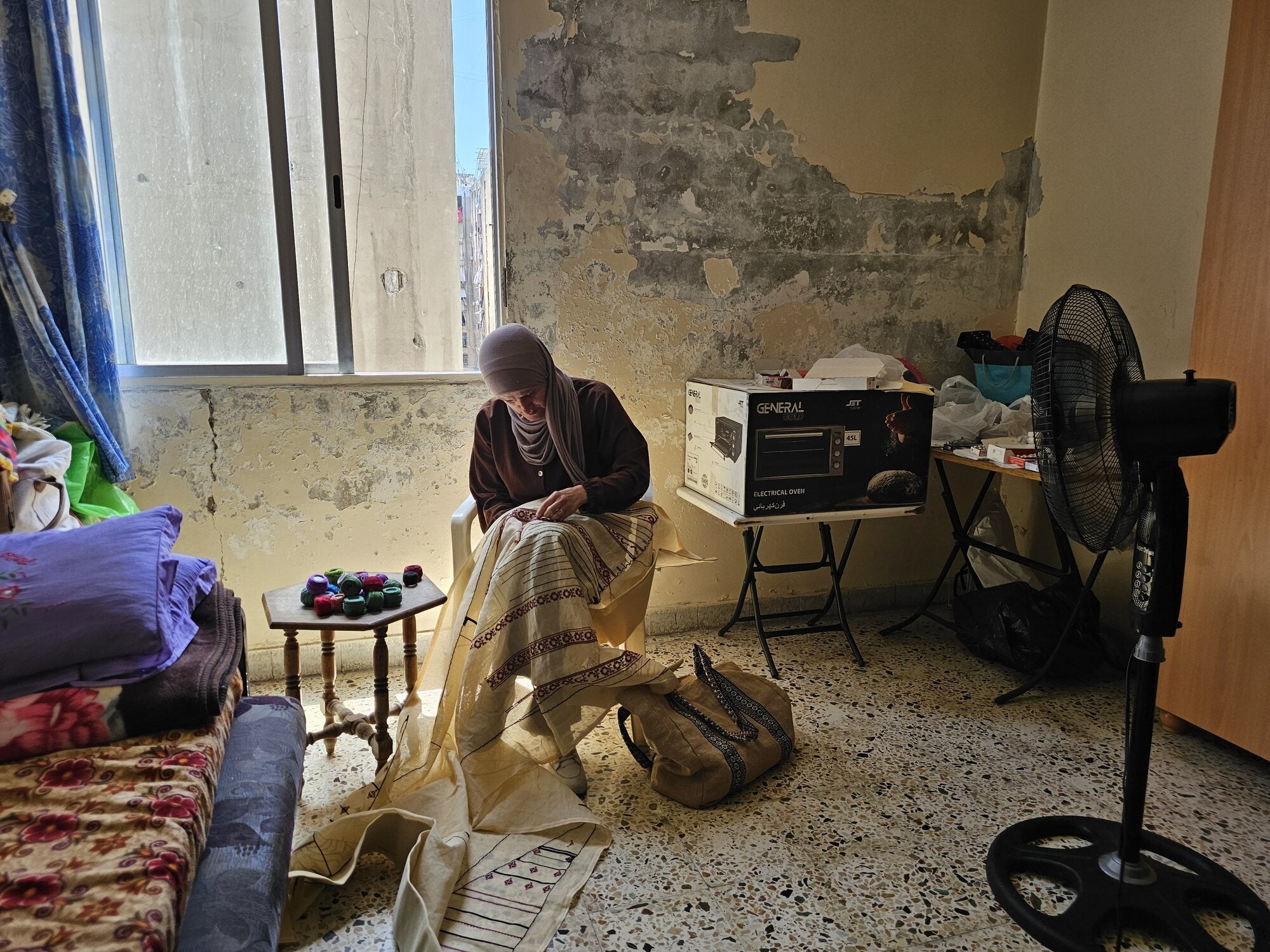
When war shatters a home, life doesn’t simply pause, it fractures.
Everything becomes a challenge. Work is difficult. Sleep is uncertain. Neighborhoods feel dangerous, and the smallest sound can trigger an alert with the fear of what may come next.
For the Palestinian embroiderers of Burj el-Shemali refugee camp near Tyre, even holding a needle became an act of strength. Palestinian embroidery is more than a traditional craft; it is a living expression of identity, memory, and belonging, carried forward through generations of Palestinian women.
Rihab Idriss, originally from Dayshum, Palestine, has been with Inaash since 1997. As the camp supervisor, she coordinates with the women embroiderers, distributes work, and remains closely connected to their lives and needs.
When the latest war in Lebanon began on March 2, the bombing was initially concentrated around the camps. The fear, noise and constant uncertainty made the intricate work of tatreez almost impossible.
Palestinian embroidery requires concentration. Every stitch must be counted. Every motif must be carefully placed. But how can a woman follow the rhythm of a pattern while straining to hear aircraft, explosions and warnings?
Through Palestinian embroidery, generations of women transform threads and patterns into powerful stories of cultural identity.
“They would try to hold onto the cloth and embroider,” Rihab explained. “But every time Israel bombed, they would drop the work and run for safety.”

Scattered Across Lebanon
As the danger intensified, the embroiderers were displaced in different directions.
Some travelled north. Others went to Beirut or Sidon. Rihab and a small group fled to the northern city of Tripoli, where they remained for 17 days.
Yet displacement offered no comfort.
While they were safe from the immediate bombing, they were separated from their homes, belongings and familiar surroundings. According to Rihab, they could not bear the feeling of exile and despite the ongoing war, they returned to Tyre and Burj el-Shemali.
Leaving one’s home is never easy, even when that home is under threat. For families shaped by earlier displacement, abandoning home once again carries a particular pain. Home may be at risk but it is still home.

A Needle: A Weapon Against Fear
The war affected the women mentally, physically and financially.
The fumes, rocket smoke, dust and destruction affected their health. Fear followed them throughout the day and into the nights. The sound of bombing made it difficult to think, work or regain any sense of calm.
Rihab herself narrowly escaped an Israeli strike on a building less than 50 metres away from her.
She remembers the panic and the terrifying sounds surrounding her. For a moment, she said, the fear was so overwhelming that she felt she was losing control.
Yet even in these conditions, the women became more attached to their embroidery.
Tatreez could not remove the danger, but it gave them something to hold onto. In those times when they were able to stitch, even briefly, they could turn their attention away from fear and destruction around them. The needles and fabric kept their hands and minds busy, with colors to choose, patterns to follow, shapes to create, giving their days a small sense of purpose.
The beauty of hand embroidery lies not only in its intricate details but also in the hands, heritage, and stories stitched into every unique creation.
Embroidery became a way of saying: life has not completely stopped.
A piece of cloth could offer a few moments of concentration. A familiar motif could reconnect their memories. Completing even a small section could restore a feeling of achievement at a time when almost everything else felt beyond their control.

Work, Independence and Survival
For the women of Inaash, embroidery is not only cultural preservation. It is also necessary work.
The income allows an embroiderer to buy her personal needs, provide for her children, support her husband, and maintain a degree of financial independence.
In difficult economic conditions, this income becomes even more essential. After years of crisis and war, many families have few remaining sources of stability.
From traditional motifs to modern designs, hand embroidery creates a bridge between Palestinian heritage and the evolving world of contemporary fashion and art.
This is why Rihab insists that Palestinian embroidery needs continuous support and regular orders.
Admiring tatreez is not enough. Its survival depends on women continuing to receive work and being paid for their skill.
Without demand, the embroidery stops. And when the work stops, the consequences are both financial and cultural.

The Fear of Losing More Than Homes
The women were not only afraid for their personal safety. They also feared what another prolonged war could mean for Inaash and Palestinian embroidery itself.
After three years of war and a severe economic crisis, they worried that the destruction of Palestinian camps in Lebanon could deliver another devastating blow, one from which the embroidery tradition and the communities sustaining it might not easily recover.
This fear is painfully understandable.
Palestinian embroidery has already survived displacement, exile, poverty and repeated wars. It has travelled across borders because women carried its stitches in their memory. But no heritage survives automatically. It survives because people continue practising it, teaching it, buying it and valuing the lives of those who create it.
Every disrupted workshop, displaced embroiderer and lost income threatens that continuity.
Keeping the Thread Unbroken
Rihab expressed deep gratitude to Inaash for continuing to help the embroiderers and doing everything possible to support them through these conditions.
But she also offered a direct appeal: the women need orders.
Buying an embroidered piece is not an abstract gesture of sympathy. It gives an embroiderer work. It helps her support her household. It allows her to maintain independence and continue practising a tradition that carries the history of Palestine.
During war, a finished piece of tatreez may look pretty and colorful, but behind it there may be a woman who stitched between explosions, displacement and fear.
She may have held the fabric to regain calm. She may have worked because her family needed the income. She may have continued because stopping felt like surrendering another part of her life.
The embroiderers of Burj el-Shemali are not asking to be reduced to symbols of suffering. They are asking for the opportunity to work, create and preserve what generations before them entrusted to their hands.
Their embroidery is beautiful. But its beauty should never make us forget the human behind every stitch.
Supporting Inaash means helping Palestinian women continue working, earning, and carrying their heritage forward, even through the most difficult circumstances.