
Grandma’s Needle: How Palestinian Stitches Keep Memories Alive
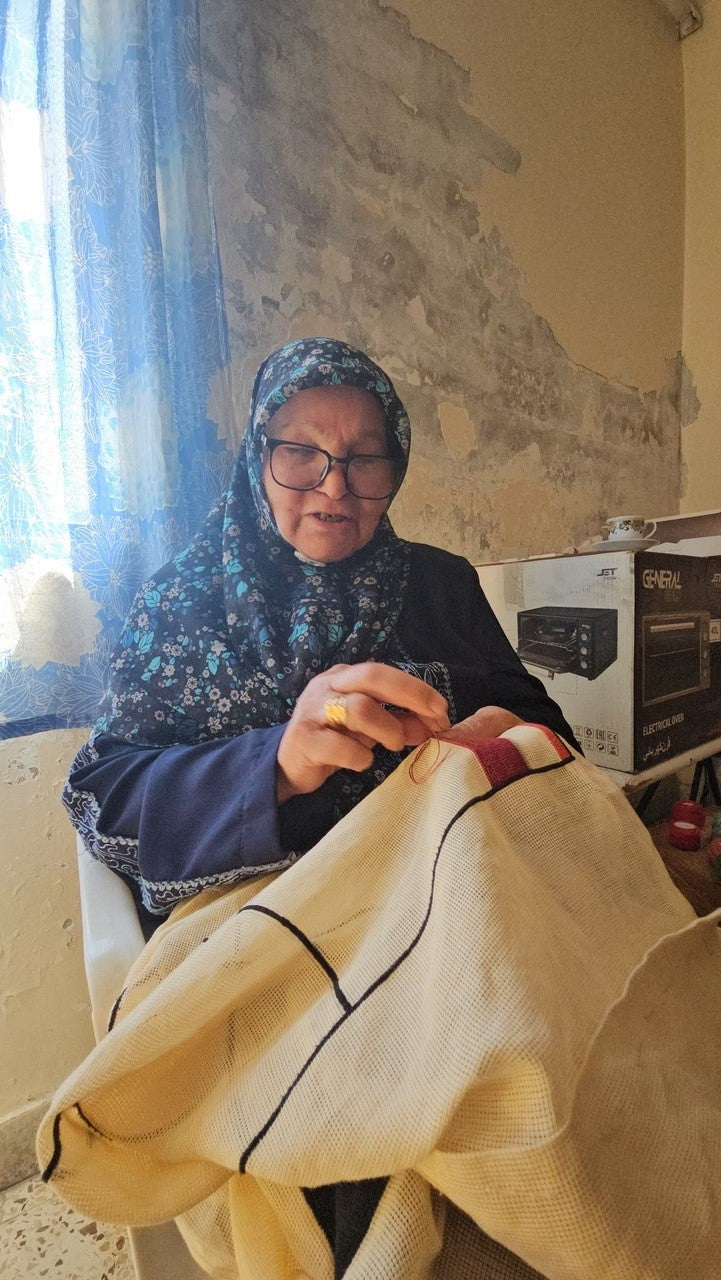
As a child, Samar’s Grandma Abir had learned how to embroider while watching her own Grandma at work. Sitting beside her Grandma day after day Abir had perfected her skills while looking forward to creating the most important garment of her life – her wedding thobe. Traditionally every young Palestinian woman dreamt of embroidering, then wearing her wedding thobe, the most precious dress she would ever own. Grandma Abir still remembered the day her own beloved Grandma was buried wearing her wedding thobe. “It was so beautiful,” she says with tears in her eyes “but now it is gone.” As was often the tradition, this most special dress was buried with its owner to be kept with her even in death.
The young Abir had paid great attention to what her Grandma had taught her and in turn, she created the wedding thobe of her dreams. Sadly that too is gone but this time lost during displacement. Samar was fascinated by her Grandma Abir’s wedding dress stories – how she remembered all the different stitches she had used, the colors and the way the patterns were arranged.
Grandma Abir’s memories and her still skillful needlework were the valuable lessons for Samar. She is a mother now and her two daughters are just as eager to absorb those memories and learn those skills. This is the power of tatreez, traditional Palestine embroidery which refuses to be diminished.
Tatreez, was never simply decoration. Its patterns and motifs evolved throughout history as a method of identification, a visual code denoting background, origin and belonging even in exile. Today, many women like Samar practice tatreez and teach it to their children. For them tatreez is not just a form of cultural preservation it also provides them with a livelihood. Drawing on their memories and the skills they learned from their elders, they produce exquisitely embroidered garments and homeware pieces sold by Inaash to provide these skilled artisans with a valuable income.
“When I stitch, I feel calm.” Samar says, “But I also feel strong. This work matters to my family.”
Together with Inaash, this once a largely domestic activity, practiced by and for women, has now become a much sought after, highly specialized handcraft embellishing a range of products from cushions and house ware to contemporary fashion items. Flowing Abayas, state of the art jackets, irresistible clutch bags and trendy tote bags carry stories from Palestine all over the world. And yet, even as tatreez enters public spaces, something deeply rooted remains to convey a sense of:
- Dignity
- Continuity
- Resilience
Nor does this evolution erase meaning. As one older artisan puts it:
“There are changes in style but never in spirit.”
The stories that were spontaneously sewn all those many years ago are still relevant today, it’s just that they are expressed differently. The message is the same, this precious heritage will not disappear.
- Remembered with love.
- Stitched with care.
- Shared from the heart.
- The story continues.
Today, as women gather together in Lebanon’s Palestinian refugee camps to arrange their fabrics, thread their needles and begin work, they often share memories like Samar talking about her Grandma.
“What happens if these memories fade?” someone asks softly.
After a long pause someone else replies.
“Do you think that they will disappear? No, they won’t disappear — not if we keep stitching.”
This is the deep significance of tatreez. Like a silent witness it preserves stories, stitched by generations for future generations. Between memory, needles and skillful hands, the next story quietly unfolds to take its place in the history of a people.